The Center for Quantum Computing and Information Technologies (QCiT) is an NSF-sponsored Industry-University Cooperative Research Center (IUCRC).

- Testbed 1 unites projects in HW and SW for Quantum Processors
- Testbed 2 unites HW and SW for Quantum Networks, Communications, Distributed Computing and Sensing
- Testbeds serve as vehicles for hands-on training
Current funded research project areas
New Assumptions and Post-Quantum Cryptography
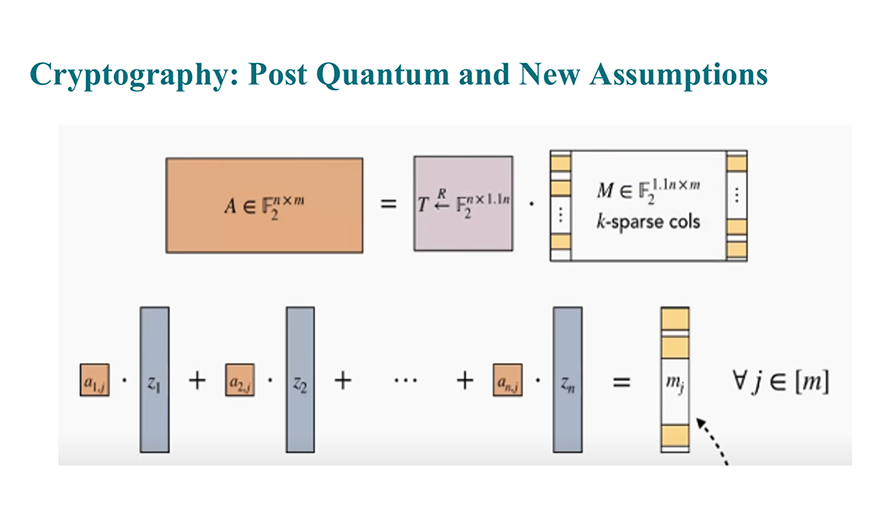
PI: Aayush Jain
As the transition to quantum-resistant standards accelerates, this project tackles two grand challenges:
- Design of foundational primitives (such as Public-Key Encryption and Signatures) and cutting-edge advanced cryptography enabling concretely efficient encrypted computation via fast homomorphic encryption and multi-party computation protocols.
- The project also promotes the study of new sources of post-quantum hardness assumptions beyond point lattices, including codes, multivariate cryptography, and high-dimensional statistics.
This research serves as a critical pillar for global cryptographic resilience:
- Diversification: By moving beyond LWE-based primitives, the project mitigates the risk of a “single point of failure” in post-quantum standards, offering a “Plan B” against future quantum cryptanalysis.
- Practical primitives: The team has successfully developed concrete implementations for advanced primitives, including Homomorphic Encryption and Private Information Retrieval (PIR).
The results of this project demonstrate that post-quantum security does not require a compromise in system performance. By delivering 3-4x faster processing and 30% smaller ciphertexts, the QCiT Center is providing the technical foundation for a seamless, high-velocity transition to quantum-resistant infrastructure.
Quantum Predictive Risk Modeling
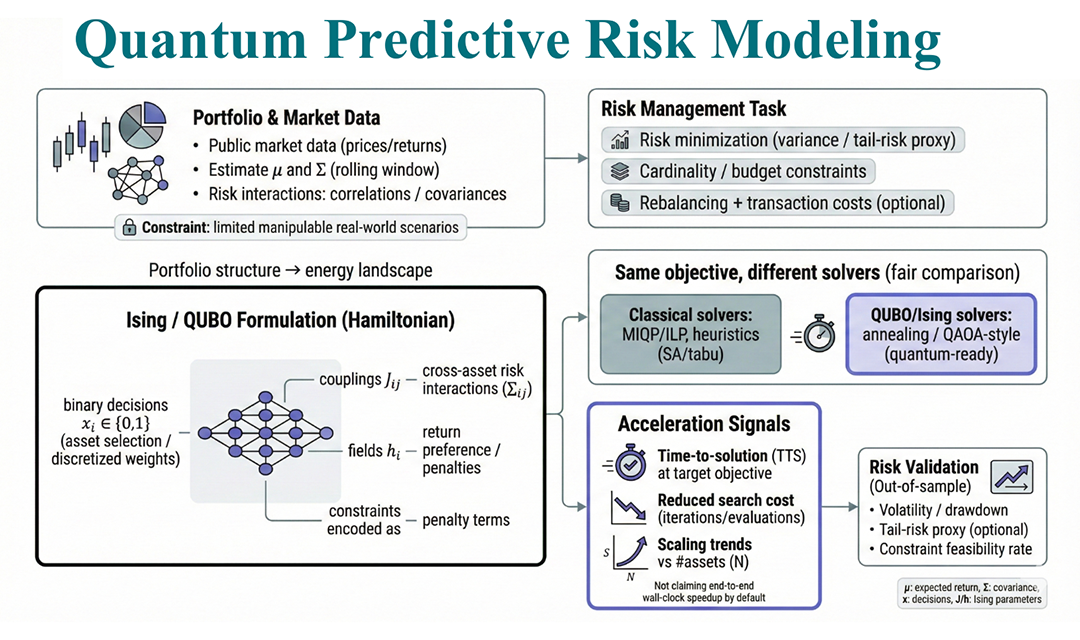
PI: Ozan Tonguz
This research introduces a foundational shift in risk modeling by transitioning from data-heavy classical AI to physics-inspired quantum Hamiltonians. By utilizing the PoTs mathematical model, the QCiT team has developed a unifying framework to encode the complex, nonlinear interdependencies of large-scale systems, such as power grids and financial networks, into an energy landscape optimized for quantum hardware.
Strategic application
- Failure Topology: The model identifies which specific sub-network failures (node or transmission link outages) trigger catastrophic cascading effects.
- Stochastic Resilience: Researchers quantified the minimum number of hardware interventions (link redundancies or node hardening) required to achieve specific target levels of network resilience.
- Cross-Platform Execution: The risk model was successfully implemented and benchmarked across two distinct quantum architectures: Quantum Annealing (D-Wave) and Analog Simulation (QuEra neutral-atom arrays).
- Multi-Domain Transferability: A key strength of the PoTs-based engine is its domain-agnostic nature
Quantum Statistical Analysis for AI/ML
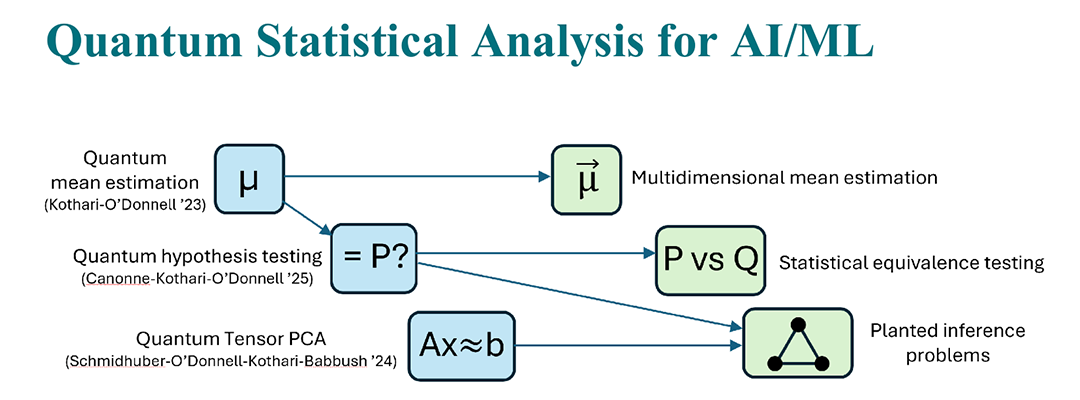
PI: Ryan O'Donnell
This research program transitions the focus of quantum algorithmic development from traditional, deterministic “worst-case” settings (e.g., integer factoring) to the stochastic domain of statistical inference. By targeting problems central to machine learning where inputs are noisy, sampled, or probabilistic, the project aims to establish the theoretical foundations and query complexity bounds for the next generation of Quantum Machine Learning (QML).
High-Dimensional Statistical Estimation
Building on the Principal Investigator’s (PI) previous breakthroughs in one-dimensional mean estimation, the project is extending these techniques to the high-dimensional regime.
- Objective: Achieving an optimal quantum speedup for estimating mean vectors of complex distributions.
- Equivalence Testing: The team is developing a novel quantum framework for statistical equivalence testing, allowing researchers to certify whether a simplified surrogate model is statistically indistinguishable from a high-complexity “ground-truth” distribution.
- Impact: This work moves beyond simple database searches to address the sophisticated pattern recognition tasks required for modern data science.
Quantum Optimization and Automated Compiler
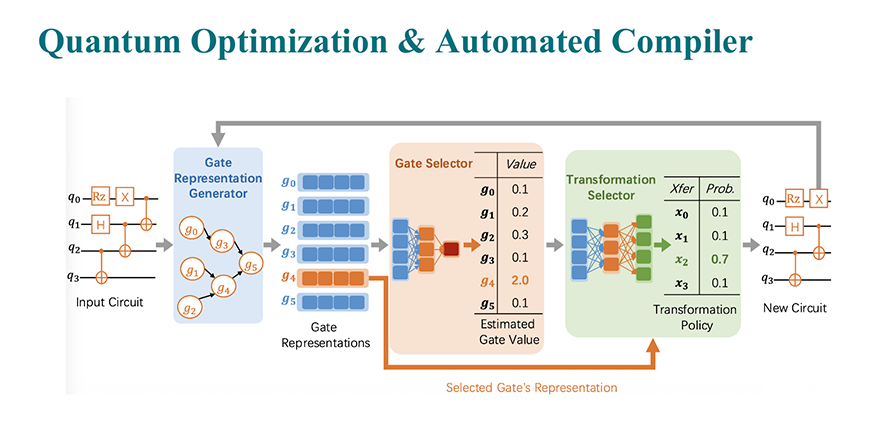
PI: Zhihao Jia, Umut Acar
This research initiative focused on overcoming the computational bottlenecks of quantum circuit simulation and the architectural constraints of Noisy Intermediate-Scale Quantum (NISQ) devices. The QCiT team successfully engineered two proprietary systems (Atlas and Quarl) to address these challenges through hierarchical distributed computing and reinforcement learning.
High-Performance Distributed Simulation (Atlas)
Atlas is a distributed, multi-GPU quantum circuit simulator designed to enhance performance and scalability. To mitigate the high communication overhead typical of distributed environments, the system utilizes a twofold optimization strategy:
- Impact: Evaluation benchmarks demonstrate that Atlas outperforms state-of-the-art GPU simulators by a factor of 2x on average. Furthermore, its ability to offload to DRAM enables the simulation of larger circuits, exceeding the performance of existing large-circuit simulators by two orders of magnitude.
Learning-Based Circuit Optimization (Quarl)
To navigate the immense search space of functionally equivalent circuits in NISQ environments, the team developed Quarl, a reinforcement learning (RL) based optimizer. Quarl addresses the challenges of varying action spaces and non-uniform state representation through:
- Neural Architecture: A Graph Neural Network (GNN) based state representation that enables both local and global circuit reasoning with the ability to perform rotation merging—a complex, non-local optimization typically requiring manual heuristic implementation—entirely through its training procedure.
- Impact: Quarl significantly outperformed existing circuit optimizers across nearly all established benchmark circuits.
AI Quantum Methods for Fraud
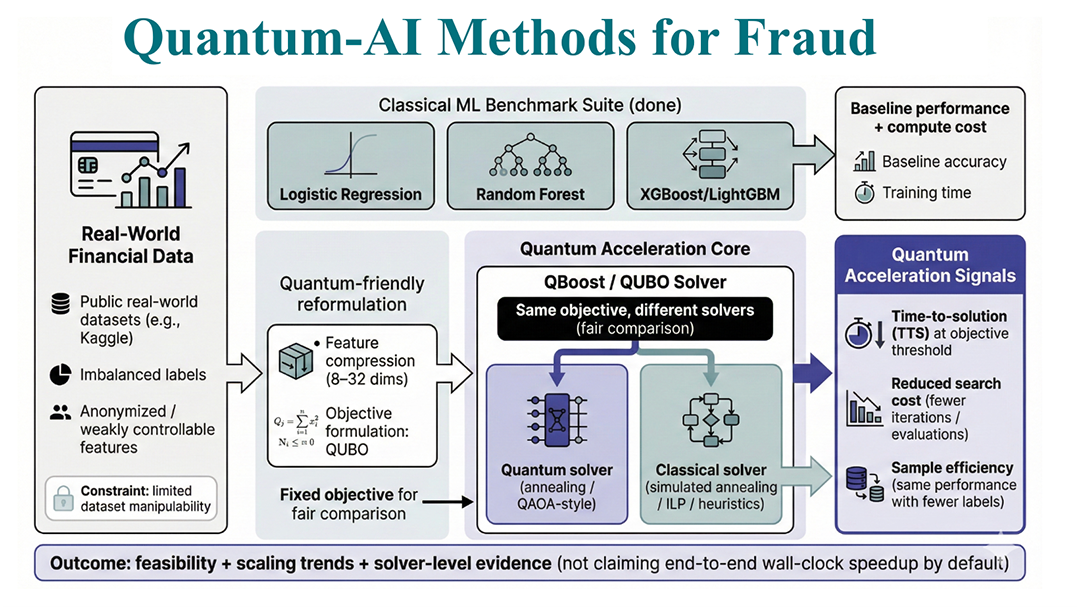
PIs: Elias Towe, Ozan Tonguz, and Bryan Routledge
This translational research establishes a high-performance fraud detection framework that integrates Graph Neural Networks (GNNs) and Online Isolation Forests (iForest). The primary objective is to evaluate and quantify the “quantum advantage” in accelerating real-time model updates, specifically addressing the rapid evolution of fraud patterns through hybrid classical-quantum computing.
By merging GNNs with quantum-accelerated online learning, this project addresses the critical need for adaptive security systems in the financial and other sectors. The results offer a definitive assessment of how quantum-classical hybrids can outperform traditional GPU-only architectures in identifying and neutralizing evolving financial threats.
Integrated Quantum Sensor for Electric & Magnetic Fields
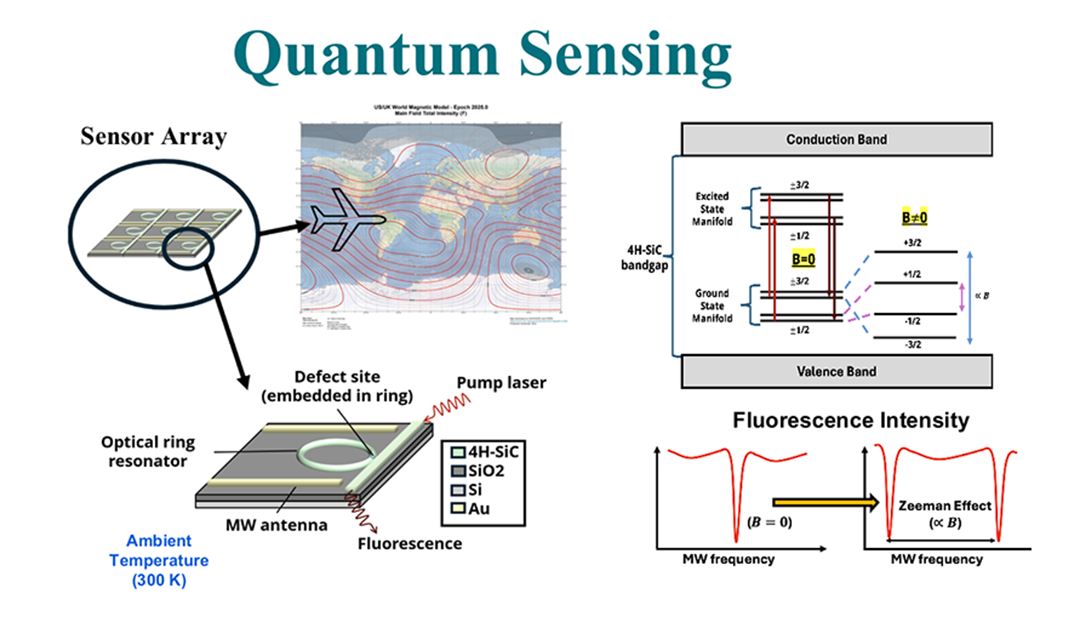
PIs: Maysam Chamanzar, Elias Towe
This project focuses on the development of high-sensitivity, solid-state quantum sensors
leveraging silicon carbide (SiC). By engineering quantum defects within the SiC bandgap, the team is creating a robust sensing platform capable of ambient-temperature detection of magnetic and electric fields, as well as temperature and pressure. This research positions SiC as a commercially viable, CMOS-compatible alternative to diamond-based quantum technologies.
Domains and impact
- Navigation: Providing high-fidelity heading data by measuring the Earth’s magnetic field in compact, chip-scale packages that implement vector magnetometry functions.
- Biomedical: Enabling non-invasive Magnetoencephalography (MEG) to monitor neural activity and cardiac magnetic fields.
- Geophysics: Improving the resolution of mineral and oil exploration and the detection of tectonic activity.
- Scaling: By successfully demonstrating quantum defect and system-level integration on a SiC semiconductor platform, this project establishes a foundation for massive scalability in quantum sensing. The transition from specialized lab-grown diamonds to industrial-grade SiC marks a critical step toward the commoditization of quantum-grade electromagnetic field detection.
Targeted research areas
Toolchain SW
- Quantum compilers
- Quantum circuit synthesis
- Simulation of quantum processors
Algorithms
- Quantum machine learning
- Engineering and business process optimization
- Hamiltonian simulation of new materials and small molecule chemistry
Hardware
- Physics-inspired hardware accelerators
- Quantum networks for hybrid quantum sensors
- Quantum networks for quantum processors
- Networks for secure quantum communications